What Is the Magic City Innovation District?
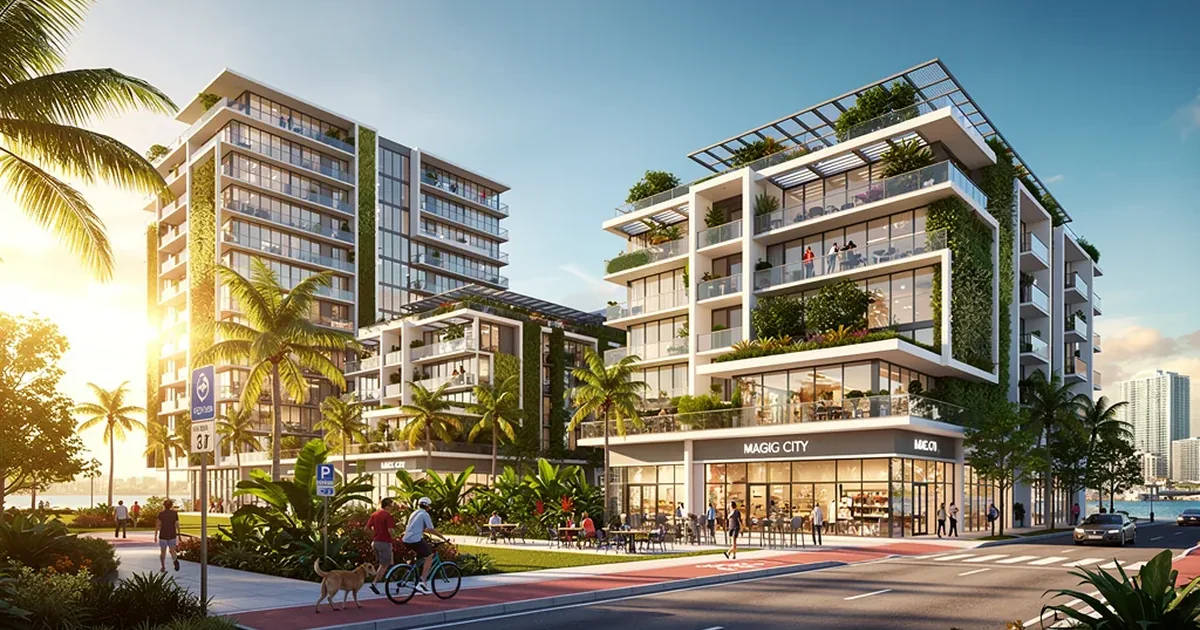
The Magic City Innovation District is a massive mixed-use development project approved for the Little Haiti neighborhood of Miami, adjacent to Wynwood's northern boundary. The project spans approximately 18 acres along NE 2nd Avenue and proposes a dense urban mixed-use development including residential towers, creative office space, retail, and cultural amenity facilities — all within the broader framework of Miami 21's T6 zoning context.
The project has been controversial — community advocacy groups representing Little Haiti's Haitian-American community have raised significant concerns about displacement and the project's impact on the neighborhood's cultural character. These concerns have shaped the project's development timeline and community benefit requirements. Understanding the project's status, timeline, and community benefit obligations is essential context for any investment decision in the surrounding area.
From a real estate investment perspective, the Magic City development's significance for surrounding property owners is twofold: it signals institutional confidence in the corridor's transformation trajectory, and it creates infrastructure and amenity investment that historically catalyzes surrounding property appreciation.
The Geography — Wynwood, Magic City, and the Innovation Corridor
Investment Strategy in the Magic City / Wynwood Corridor
The investment thesis for the Magic City / Wynwood corridor in 2026 is built on a specific sequence of neighborhood transformation that Miami has demonstrated repeatedly — Brickell, Edgewater, Wynwood itself — each following a similar pattern:
- Phase 1 — Early institutional commitment: A major project like Magic City signals that institutional capital has underwritten the neighborhood's transformation. Land values in the immediate area begin repricing in anticipation of development
- Phase 2 — Adjacent appreciation: Properties within 4–8 blocks of the institutional project begin appreciating as infrastructure improvements, new residents, and retail follow the development. This is where individual investors with the right timing capture significant value
- Phase 3 — Full corridor repricing: The entire corridor between established nodes (Wynwood arts district south, Magic City north) reprices to reflect the continuous urban fabric. Early-phase investors have fully appreciated
Little Haiti's Haitian-American community has been vocal and organized in responding to the Magic City development and the broader displacement pressures in the corridor. This community advocacy has shaped the project's community benefit obligations and is an active factor in the political and regulatory environment for development in this area.
Get personalized guidance on FHA loans, down payment assistance, multifamily investing, and South Florida real estate opportunities — from a licensed GC who'll walk the property with you.
Investors operating in this corridor have a responsibility to understand the community context — both as a matter of ethics and as a practical investment consideration. Projects that work with the community rather than against it have smoother approval pathways and lower political risk. This is part of the strategic context I discuss with every investor considering positions in the Magic City / Wynwood corridor.
What My GC Background Means for Magic City Corridor Investments
The properties available for individual investor acquisition in the Magic City / Wynwood corridor are predominantly the same pre-1980 concrete block buildings that define the broader Wynwood multifamily market — with the specific complications that Little Haiti's housing stock carries: a higher proportion of rent-stabilized legacy tenants, more significant deferred maintenance in buildings where owner investment has been minimal, and more frequent 40-year recertification exposure.
Walking these properties as a licensed General Contractor before any offer is not optional in this corridor — it's the only way to understand what you're actually buying. I assess structural condition, electrical panel types, plumbing material and configuration, roof remaining life, and 40-year cert exposure on every property walkthrough.