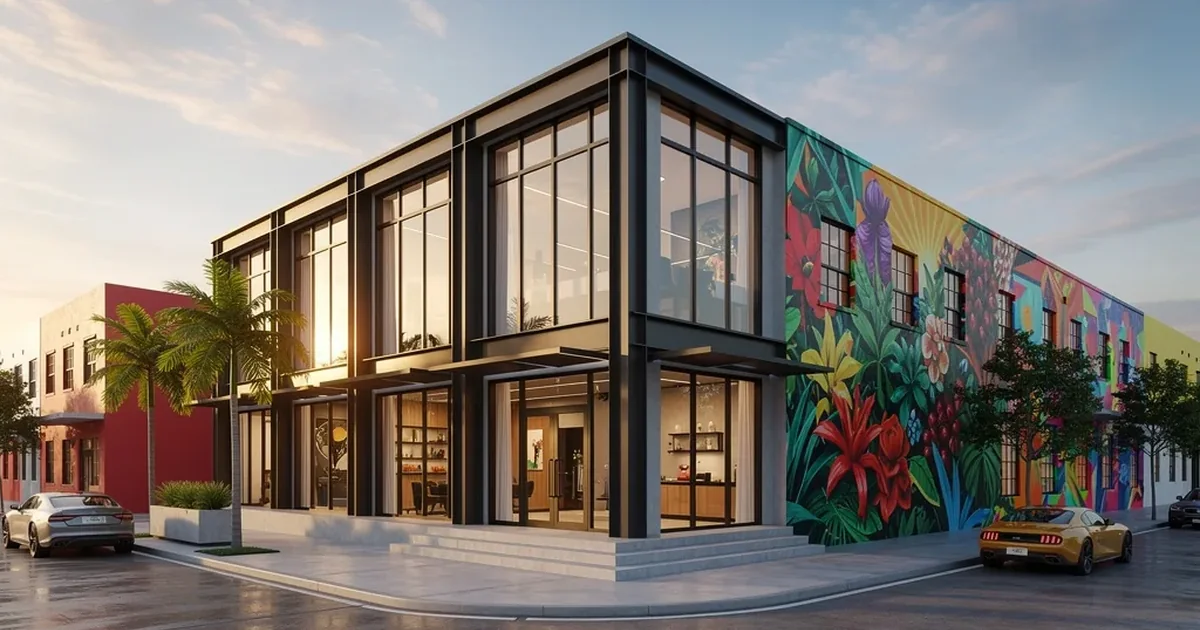
Why Wynwood Is Unlike Any Other Miami Investment Market
Wynwood's transformation from a warehouse district into one of Miami's most visited cultural destinations has been one of the most dramatic neighborhood evolutions in American real estate history. Between 2005 and 2026, Wynwood went from industrial vacancy to a $150-per-square-foot retail corridor — and the residential and mixed-use development pressure that transformation created has fundamentally changed the investment calculus here.
For investors, Wynwood's appeal is not current cash flow — cap rates here are 4–5.5%, which is modest by Miami-Dade standards. The Wynwood thesis is built on three compounding value drivers:
- T6 zoning density upside: Miami 21's T6-8 transect designation across much of Wynwood allows vertical mixed-use development of extraordinary density — potentially 8+ stories with ground-floor retail and residential above. The gap between a property's current use value and its development potential under T6-8 is the Wynwood investment opportunity
- Below-market income on legacy assets: Properties acquired with existing rental income — older apartment buildings, legacy commercial tenants — provide a current income floor while the development potential matures or until zoning changes make redevelopment feasible
- Institutional capital displacement to early movers: As institutional developers bid up flagship Wynwood sites, smaller adjacent properties appreciate in their wake. The informed individual investor who positions in the transition zone before institutional attention arrives captures outsized appreciation
Understanding T6 Zoning in Wynwood — What It Actually Means for Investors
Miami 21 is Miami's form-based zoning code, organized around transect zones from T1 (natural) to T6 (urban core). Wynwood sits primarily in T6-8 and T6-12 — the highest density transect designations outside of the Central Business District.
| Transect Zone | Max Height | Max FAR | Uses Permitted | Location in Wynwood |
|---|---|---|---|---|
| T6-8 | 8 stories | 3.2 | Residential, commercial, lodging, office, civic | Core Wynwood, NW 2nd Ave corridor |
| T6-12 | 12 stories | 5.0 | All T6-8 uses + increased density bonuses | Major arterials, gateway sites |
| T6-24 (adjacent) | 24+ stories | 7.5+ | Maximum density — towers | Edgewater / Wynwood border |
| D3 (Wynwood SD) | Varies | Special | Wynwood Arts District overlay — art-related use requirements | Core arts district |
A 5,000 sq ft lot in T6-8 zoning with a 3.2 FAR can support up to 16,000 sq ft of total floor area across up to 8 stories. A legacy property on that lot currently generating $60,000/year in rental income — valued at $1,200,000 on a 5% cap — could support a development producing $800,000+/year in income. The gap between those two valuations is the development upside — and it's only accessible to investors who understand what the zoning actually allows.
This analysis requires knowing Miami 21's specific setback requirements, parking standards (or waivers in T6), affordable housing density bonus programs, and the design review process through the Urban Development Review Board. My commercial real estate background covers all of these.
Investment Property Types in Wynwood — What's Available and What Makes Sense
The 40-Year Certification Opportunity in Wynwood
T6-8 vs T6-12 vs T6-24 — the difference between 8 floors and 24 floors on the same block. Open code violations resolved as condition of sale. Roland has walked every Wynwood block and knows which deals pencil at T6 density.
Wynwood's housing stock is predominantly pre-1980 construction — meaning a significant portion of the neighborhood's buildings are either approaching or already past the 40-year recertification threshold. This creates a steady supply of motivated seller situations that sophisticated investors can exploit.
Here's why these situations are uniquely valuable in Wynwood specifically:
- The property is worth more as development than as a recertified operating building: In many cases, the cost of recertification remediation approaches or exceeds the marginal value of recertifying the current use. For owners who understand this, selling to a development-oriented buyer is rational
- The seller has a defined problem with a defined timeline: A recertification order creates urgency. A seller with 90 days to comply before a potential vacate order is more motivated than a seller with no particular reason to transact
- The GC assessment creates credible negotiating position: Walking the property as a licensed contractor, assessing the remediation scope, and presenting a credible offer that reflects the actual remediation cost is a specific capability that separates credible buyers from speculators
I actively track 40-year recertification situations in Wynwood and the adjacent ZIP 33127 corridor. Call 305-731-0387 or email Info@Realtor007.ai to be notified of situations that match your investment criteria.