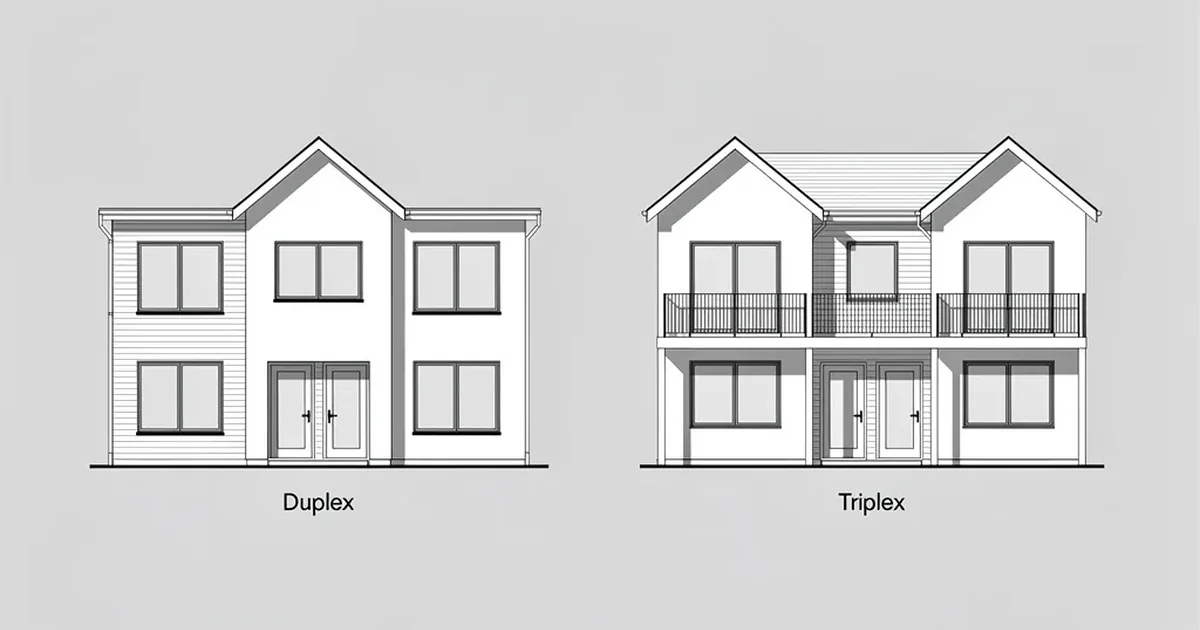
The Core Difference That Matters Most
A duplex (2 units) and a triplex (3 units) are both classified as residential real estate by lenders — allowing conventional and FHA financing with residential terms. This classification ends at 4 units. A 5-unit property is commercial. This distinction makes 2–4 unit properties uniquely valuable as investment entry points: residential financing terms (lower rates, higher LTV) on income-producing assets.
Between the duplex and triplex specifically, the differences are: one additional income stream, one additional tenant relationship, one additional maintenance obligation, and a typically higher purchase price — partially or fully offset by higher gross income.
Financing Comparison — Duplex vs Triplex
| Factor | Duplex (2 Units) | Triplex (3 Units) |
|---|---|---|
| FHA (owner-occupied) loan limit — Miami-Dade 2026 | $994,050 | $1,201,150 |
| FHA min down payment (owner-occupied) | 3.5% | 3.5% |
| Conventional (non-owner-occupied) down | 25% | 25% |
| Rental income used to qualify (FHA) | 75% of non-owner units | 75% of non-owner units |
| DSCR loan availability | Yes | Yes |
| Key difference | Both use the same financing structures. The triplex generates more income, which helps DSCR and FHA rental income qualification — but the higher purchase price may require more capital. | |
Cash Flow Analysis — South Florida 2026
A realistic comparison for the Homestead / South Dade market:
| Item | Duplex Example | Triplex Example |
|---|---|---|
| Purchase price | $390,000 | $480,000 |
| Down payment (25%) | $97,500 | $120,000 |
| Loan amount | $292,500 | $360,000 |
| Monthly P&I (7.5%) | $2,046 | $2,519 |
| Insurance (annual) | $5,500 / $458/mo | $6,500 / $542/mo |
| Property taxes | $550/mo | $680/mo |
| Gross monthly rent | $4,200 (2 × $2,100) | $6,000 (3 × $2,000) |
| Vacancy (8%) | −$336 | −$480 |
| Mgmt (9%) | −$351 | −$501 |
| Maintenance reserve | −$260 | −$320 |
| Total expenses | $3,961 | $4,862 |
| Monthly cash flow | +$239 | +$1,138 |
| Cash-on-cash return (annual) | 2.9% | 11.4% |
The triplex generates significantly better cash flow in this example — the additional unit adds $1,800/month in gross rent while adding only $654/month in PITI. This is the economies-of-scale argument for triplexes: the fixed costs (insurance, taxes, maintenance overhead) are spread across 3 units instead of 2.
Market Availability — Duplexes Are More Common
In South Florida's residential markets, duplexes significantly outnumber triplexes and quadplexes. The Homestead and South Dade corridor has a large inventory of CBS block duplexes built from the 1960s through the 1990s. Triplexes are less common — often purpose-built or converted, and typically found in denser urban neighborhoods (Little Haiti, Hialeah, parts of North Miami) rather than suburban South Dade.
This supply dynamic has practical implications: a duplex investor has more properties to choose from, more comparables for valuation, and a larger resale market. A triplex investor may face a smaller acquisition market but also less competition for the best deals.
Management Complexity
Three tenants versus two is a 50% increase in:
- Annual lease renewals to manage
- Maintenance calls and repair coordination
- Potential vacancy events
- Tenant screening and placement requirements
For a beginning investor self-managing, the duplex is the more appropriate starting point — lower complexity while establishing landlording skills, processes, and relationships with reliable tradespeople. The triplex makes more sense once systems are established or when using a property manager from day one.
GC Assessment Differences
Both duplex and triplex properties share the same GC assessment priorities: electrical panel type, roof age and condition, plumbing material, HVAC system age and independence for each unit. The triplex adds one consideration: three independent HVAC systems (ideally), three sets of appliances, and one additional bathroom. The additional scope per unit is roughly linear — more systems to assess, not more complex systems.
One specific triplex GC consideration: unit separation quality. Three-unit buildings are more likely to have shared mechanical systems (one HVAC serving multiple units, shared water heater) than duplexes — particularly in converted single-family triplexes. Verify each unit has independent systems before purchase.
Answer a few simple questions and discover homebuyer programs, financing options, grants, and next steps — tailored to your South Florida situation.
Take The Homebuyer Qualification Quiz ›Which Is Right for You?
- Choose a duplex if: You're a first-time investor who wants to start with lower complexity. You want to FHA owner-occupy and prefer living with one neighbor rather than two. Your capital allows the 3.5% FHA down payment but limits the non-owner-occupied 25%. The duplex inventory in your target market is stronger
- Choose a triplex if: You have sufficient capital for the higher purchase price. You are comfortable with property management or plan to hire a PM from day one. The cash flow difference justifies the additional complexity in your financial model. You find a well-maintained triplex with independent unit systems at the right price