What Is a Seawall and Why Does It Matter
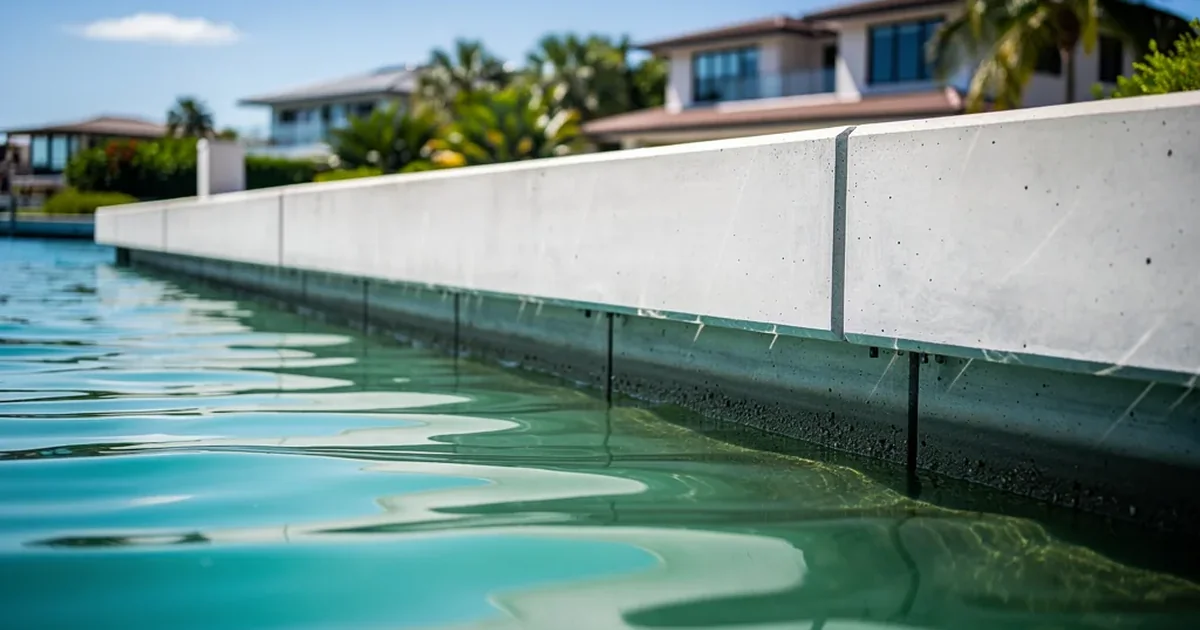
A seawall is a structure — typically concrete, vinyl sheet pile, or treated timber — installed at the waterline of a canal or waterfront property to hold the land in place and prevent erosion. In South Florida's canal-front neighborhoods (Cutler Bay, Miami, Fort Lauderdale's waterways, Boca Raton canals, and throughout the Intracoastal), nearly every canal-front home has one.
The seawall is what holds the soil of your backyard, your patio, and the foundation adjacent to the water in place. When it fails — which it does on its own timetable, not yours — the soil behind it begins to migrate into the canal, the land sinks, and the consequences to the structure above can be severe. A visible seawall failure means you have passed the point where repair is sufficient and entered replacement territory.
Seawall Lifespan by Type
| Type | Typical Lifespan in SF | Signs of End-of-Life | Notes |
|---|---|---|---|
| Cast-in-place concrete | 25–40 years | Spalling, horizontal cracking, lean toward water | Most common in South Dade canal homes |
| Precast concrete panels | 25–40 years | Joint failures, panel cracking, lean | Common in 1980s–1990s waterfront construction |
| Vinyl / composite sheet pile | 40–75 years | Deformation, separation at ties | Modern standard — best lifespan |
| Treated timber (older) | 15–25 years | Rot, insect damage, structural flex | Pre-1980 installations — usually needs replacement |
| Aluminum | 20–35 years | Oxidation, pitting, structural weakness | Less common — inspect carefully |
Signs of Seawall Failure — What I Look For
A standard home inspector checks the seawall visually from land. I look at the same seawall as a licensed contractor with specific knowledge of what early failure looks like:
- Lean toward the water: Any measurable tilt of the seawall cap toward the water indicates the wall is moving. Minor lean (1–2 degrees) may be stable and monitorable. Significant lean (5+ degrees) indicates active failure. Check by standing at water level and sighting along the top of the wall
- Horizontal cracking at the mid-section of concrete panels: The greatest bending stress on a seawall occurs at approximately mid-depth. Horizontal cracks at this level indicate the wall is flexing beyond its design load — soil pressure from behind is exceeding the wall's capacity. This is a structural failure sign
- Spalling concrete (concrete surface breaking away): Salt water corrodes the steel rebar inside concrete seawalls. As the rebar corrodes, it expands, cracking and breaking off the concrete cover above it (spalling). Surface spalling exposes more rebar to saltwater corrosion, accelerating the failure cycle
- Gaps at the top of the seawall cap where it meets the property: The seawall cap is the coping at the top that seals the joint between the wall and the property. Gaps here indicate the wall has moved away from the land — soil is actively migrating behind the wall into the canal
- Sink holes or depressions in the lawn near the seawall: As soil migrates through or under a failing seawall into the canal, voids form behind the wall. These voids eventually collapse to the surface as small depressions or sinkholes in the lawn adjacent to the water. This is a late-stage failure sign
- Erosion at the base of the seawall visible at low tide: Undermining at the base — where water has scoured soil from behind the wall at its base — is the most serious finding. Once the base is undermined, complete failure (the wall falling into the canal) becomes a near-term risk
Seawall Repair vs. Replacement — The Cost Decision
Not every seawall issue requires full replacement. Here is the cost decision framework:
- Cap replacement and joint resealing: $3,000–$8,000. Appropriate when the wall structure is sound but the cap and sealing have deteriorated. Does not address structural issues
- Concrete panel crack injection and rebar treatment: $5,000–$15,000. Appropriate for moderate cracking without lean or base undermining. Extends life 5–15 years depending on remaining structural integrity
- Helical anchor or tie-back installation: $10,000–$25,000. Adds anchoring behind the wall to resist soil pressure when the wall is leaning or flexing. Buys additional life on an otherwise-sound structure
- Full seawall replacement: $40,000–$150,000. Required when structural integrity is compromised, when lean is significant, or when base undermining is present. Cost varies by linear footage (typically $400–$800 per linear foot installed) and material choice. A typical South Dade canal lot with 75 feet of seawall frontage: $30,000–$60,000 for vinyl replacement
Standard homeowners insurance in Florida does not cover seawall replacement due to natural deterioration or standard erosion. Some policies cover sudden, accidental damage (like a boat strike), but the gradual failure of an aging seawall is an owner-responsibility maintenance item — not an insurance claim.
Answer a few simple questions and discover homebuyer programs, financing options, grants, and next steps — tailored to your South Florida situation.
Take The Homebuyer Qualification Quiz ›This means a failing seawall at purchase is entirely your financial responsibility. At $40,000–$150,000, it is the largest single uninsured exposure in South Florida waterfront real estate. Get a seawall inspection before offering on any canal or waterfront property.
How to Get a Proper Seawall Inspection
A standard home inspector checks the seawall from land — visible surface condition only. A proper seawall inspection for a purchase decision involves a licensed marine contractor or seawall engineer who:
- Views the wall from the water at low tide (rents a kayak or uses a small boat) to assess the base condition
- Probes behind the wall with a rod to detect voids in the soil behind the wall
- Uses a transit level to measure lean accurately
- Provides a written assessment with a remaining useful life estimate and recommended action
Cost: $400–$800 for a professional seawall inspection. On a $600,000 waterfront purchase, this is the highest-ROI inspection investment you can make. Request it specifically during the inspection period — it is not included in a standard home inspection.